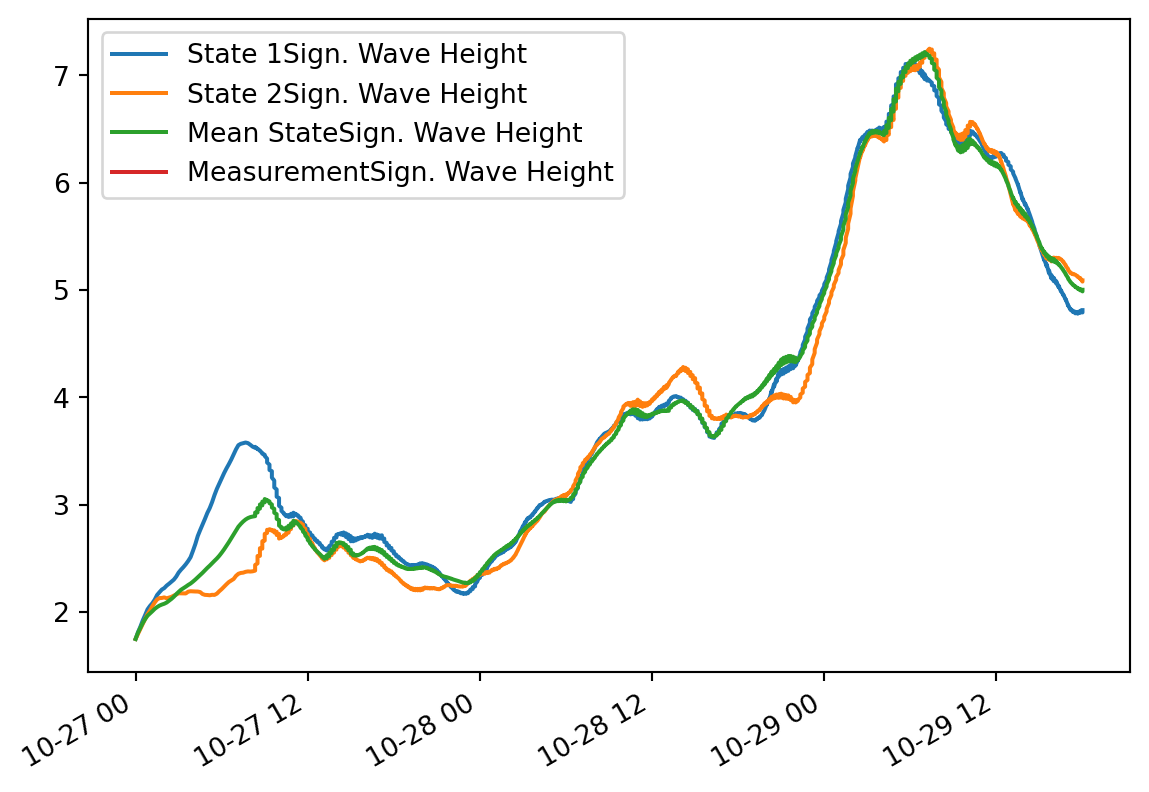
A dfs0 file is also called a time series file.
Working with data from dfs0 files are conveniently done in one of two ways:
Read Dfs0 to Dataset
import mikeio= mikeio.read("../data/da_diagnostic.dfs0" )
<mikeio.Dataset>
title: Diagnostic
dims: (time:744)
time: 2017-10-27 00:00:00 - 2017-10-29 18:00:00 (744 non-equidistant records)
geometry: GeometryUndefined()
items:
  0:  State 1Sign. Wave Height <Significant wave height> (meter)
  1:  State 2Sign. Wave Height <Significant wave height> (meter)
  2:  Mean StateSign. Wave Height <Significant wave height> (meter)
  3:  MeasurementSign. Wave Height <Significant wave height> (meter)
Selecting items
Items can be selected by name, index, or wildcard:
= mikeio.read("../data/da_diagnostic.dfs0" , items= [0 , 2 ])
<mikeio.Dataset>
title: Diagnostic
dims: (time:744)
time: 2017-10-27 00:00:00 - 2017-10-29 18:00:00 (744 non-equidistant records)
geometry: GeometryUndefined()
items:
  0:  State 1Sign. Wave Height <Significant wave height> (meter)
  1:  Mean StateSign. Wave Height <Significant wave height> (meter)
= mikeio.read("../data/da_diagnostic.dfs0" , items= "*State*" )
<mikeio.Dataset>
title: Diagnostic
dims: (time:744)
time: 2017-10-27 00:00:00 - 2017-10-29 18:00:00 (744 non-equidistant records)
geometry: GeometryUndefined()
items:
  0:  State 1Sign. Wave Height <Significant wave height> (meter)
  1:  State 2Sign. Wave Height <Significant wave height> (meter)
  2:  Mean StateSign. Wave Height <Significant wave height> (meter)
Subsetting in time
Use sel for label-based or isel for positional indexing:
= mikeio.read("../data/da_diagnostic.dfs0" )= slice ("2017-10-27 01:00" , "2017-10-27 02:00" ))
<mikeio.Dataset>
title: Diagnostic
dims: (time:7)
time: 2017-10-27 01:00:00 - 2017-10-27 02:00:00 (7 records)
geometry: GeometryUndefined()
items:
  0:  State 1Sign. Wave Height <Significant wave height> (meter)
  1:  State 2Sign. Wave Height <Significant wave height> (meter)
  2:  Mean StateSign. Wave Height <Significant wave height> (meter)
  3:  MeasurementSign. Wave Height <Significant wave height> (meter)
= slice (0 , 5 ))
<mikeio.Dataset>
title: Diagnostic
dims: (time:5)
time: 2017-10-27 00:00:00 - 2017-10-27 00:40:00 (5 records)
geometry: GeometryUndefined()
items:
  0:  State 1Sign. Wave Height <Significant wave height> (meter)
  1:  State 2Sign. Wave Height <Significant wave height> (meter)
  2:  Mean StateSign. Wave Height <Significant wave height> (meter)
  3:  MeasurementSign. Wave Height <Significant wave height> (meter)
Absolute vs relative time axis
Absolute-time dfs0 files use calendar timestamps (pandas.DatetimeIndex), while relative-time dfs0 files use elapsed time (pandas.TimedeltaIndex).
import pandas as pd= mikeio.read("../data/da_diagnostic.dfs0" )type (ds_abs.time), ds_abs.time[:3 ]= mikeio.read("../data/eq_relative.dfs0" )type (ds_rel.time), ds_rel.time[:3 ]
(pandas.TimedeltaIndex,
 TimedeltaIndex(['0 days 00:00:00', '0 days 00:00:00.111803',
                 '0 days 00:00:00.223606'],
                dtype='timedelta64[ns]', freq=None))
To convert relative times to calendar timestamps, choose a reference start time and add the timedeltas:
= pd.Timestamp("2017-10-27 00:00:00" )+ ds_rel.time[:3 ]
DatetimeIndex([       '2017-10-27 00:00:00', '2017-10-27 00:00:00.111803',
               '2017-10-27 00:00:00.223606'],
              dtype='datetime64[ns]', freq=None)
From Dfs0 to pandas DataFrame
= ds.to_dataframe()
2017-10-27 00:00:00
1.749465
1.749465
1.749465
1.72
2017-10-27 00:10:00
1.811340
1.796895
1.807738
NaN
2017-10-27 00:20:00
1.863424
1.842759
1.853422
NaN
2017-10-27 00:30:00
1.922261
1.889839
1.897670
NaN
2017-10-27 00:40:00
1.972455
1.934886
1.935281
NaN
From pandas DataFrame to Dfs0
import pandas as pd= pd.read_csv("../data/co2-mm-mlo.csv" , parse_dates= True , index_col= "Date" , na_values=- 99.99 = mikeio.from_pandas(df)"mauna_loa_co2.dfs0" )
Specifying EUM types and units
By default, items created from a DataFrame have undefined EUM types. You can specify them explicitly:
from mikeio import ItemInfo, EUMType, EUMUnit= df[["Average" ]].dropna()= mikeio.from_pandas(= [ItemInfo("CO2" , EUMType.Concentration_1)],
<mikeio.Dataset>
dims: (time:720)
time: 1958-03-01 00:00:00 - 2018-09-01 00:00:00 (720 non-equidistant records)
geometry: GeometryUndefined()
items:
  0:  Average <Concentration 1> (gram per meter pow 3)
File title
DFS files have a title field shown e.g. in MIKE Zero. The title is read from the file and preserved through processing. You can set it before writing:
= mikeio.read("mauna_loa_co2.dfs0" )= "Mauna Loa CO2" "mauna_loa_co2.dfs0" )
Accumulated datavalue type
Some dfs0 items use an accumulated data value type rather than the default instantaneous type. This is common for precipitation data and can be specified using the data_value_type argument of mikeio.ItemInfoMIKE documentation for guidance on which type to use for your setup.
Rainfall amounts (e.g. mm) are often configured as StepAccumulated:
from mikeio import ItemInfo, EUMType= ItemInfo("Rainfall" ,= "StepAccumulated" ,
Rainfall <Rainfall> (millimeter) - StepAccumulated
Precipitation rates (e.g. mm/hour) are often configured as MeanStepBackward:
= ItemInfo("Precipitation" ,= "MeanStepBackward" ,
Precipitation <Precipitation Rate> (mm per day) - MeanStepBackward
Cleanup:
import os"mauna_loa_co2.dfs0" )